
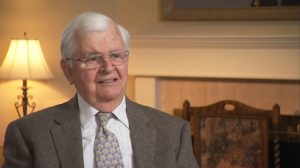
We all bear the marks of those who discipled us. Here are three convictions I hold dearly because I was discipled by Dr James Houston (who passed away on March 15, 2026 at the age of 103), and nurtured by Regent College, the school he helped to start.
- No clergy-laity distinction
In the New Testament, all of God’s people are called and anointed for service. There is no special clergy class that parallels the Old Testament Levitical priesthood. We see this “democratisation of ministry” at Pentecost when the Spirit was poured out on all. Indeed, God’s people are now a priesthood of believers (1 Peter 2:9).
Churches must recognise and respect those whom God has called to be their leaders, but leadership is a role they have been called to play. The ministry belongs to all. One way to remove the unnecessary clergy-laity divide is to understand that all are clergy. In the words of Houston’s colleague, Paul Stevens,
The word ‘clergy’ comes from the Greek word kleros, which means the ‘appointed or endowed’ ones. It is used in Scripture not for the leaders of the people but for the whole people. Ironically the church in its constitution is a people without laity in the usual sense of that word, but full of clergy in the true sense of that word — endowed, commissioned and appointed by God to continue God’s own service and mission in the world. (1)
Most denominations still work with some clergy-laity distinction. I believe a return to this understanding will mobilise and empower all of God’s people to serve and relieve some of the unrealistic expectations many churches have of their “clergy”.
- No sacred-secular divide
One corollary of a “no clergy-laity” distinction also means that there is no unnecessary division of work between sacred and secular. Although we seem to be moving away from this unbiblical distinction, there remains a belief that work that is linked to the church is sacred, e.g., pastors, missionaries, theological educators; but other professions, e.g., cab drivers, teachers, business people, florists, involve doing secular work. Most times, when a church challenges people to consider if God is calling them to ministry, it is to encourage them to consider if they are being called to some kind of church-related vocation.
This is ironic because in the creation account, human beings were made in God’s image and were to represent God to oversee His creation. And God needs all sorts of people doing all sorts of things for His world to flourish. I sometimes teach on the theology of daily work and I am very glad when teachers and nurses tell me that, for the first time, they realise that when they wake up in the morning and go to work, they are doing God’s work.
This does not mean that those who ply their trade outside the church have no ministry in the church. After all, all are called to serve in the body of Christ, though the proportion of time and energy they can give to ministry in the church will not be the same as for those who are church staff. Having said that, I must add that there are now more and more bi-vocational pastors who give time to work both in church and in the marketplace.
The education ministry of the church must then be committed to equipping her people to serve in their diverse roles, in church, family, and in the world. A lot of Christian equipping seems to be focused on equipping people for their work in the context of church. Interestingly, Houston’s graduate work was in geography, not theology, but he brought excellence into all the things he taught.
- The primacy of friendship
Perhaps the most important lesson I learnt from Houston was his commitment to friendship as the primary spiritual discipline in Christian life and formation. This makes absolute sense when we remember that our God is a Triune God who exists in perpetual relationship. It makes perfect sense that in the Farewell Discourse (John 15), Jesus calls His disciples “friends” and tells them to love each other as He has loved them; with sacrificial friendship. Here, Houston writes something that I hold very dear:
I believe that, rather than professional pursuits or even writing meaningful books, the prime action of our lives is the face-to-face encounter with others, bringing God’s presence into their lives by being “living epistles,” as the apostle puts it. Daily interruptions while working provide a continual reminder that thinking is meaningless without action, indeed that action is meaningless without the cultivation of friendships. (2)
It is costly to love like this. There is no mass production in friendship. But I believe it is central to Christian community and ministry. It is the basic conviction that drives the ministry of Graceworks. I am deeply disturbed by a world and a church enamoured with technique, knowledge, and productivity. Too often we chase effectiveness at the cost of true friendship.
I am Asian and so I would address Dr Houston by his title. He would correct me every time I did that, insisting that I call him Jim. It took me awhile to be comfortable doing that. So thank you, Jim, for these precious lessons you taught me. I do not know how many years the Lord will give me. If I can live as long as you have, I will have three decades more to go! But in whatever time God gives, and if health permits, I will continue to fight for these lessons I have learnt from you, with the weapons you used — patient love and prayer.
(1) The Other Six Days, (Grand Rapids, MI: Eerdmans, 1999), 5.
(2) Joyful Exiles, [Downers Grove, IL: InterVarsity Press, 2006], 177.