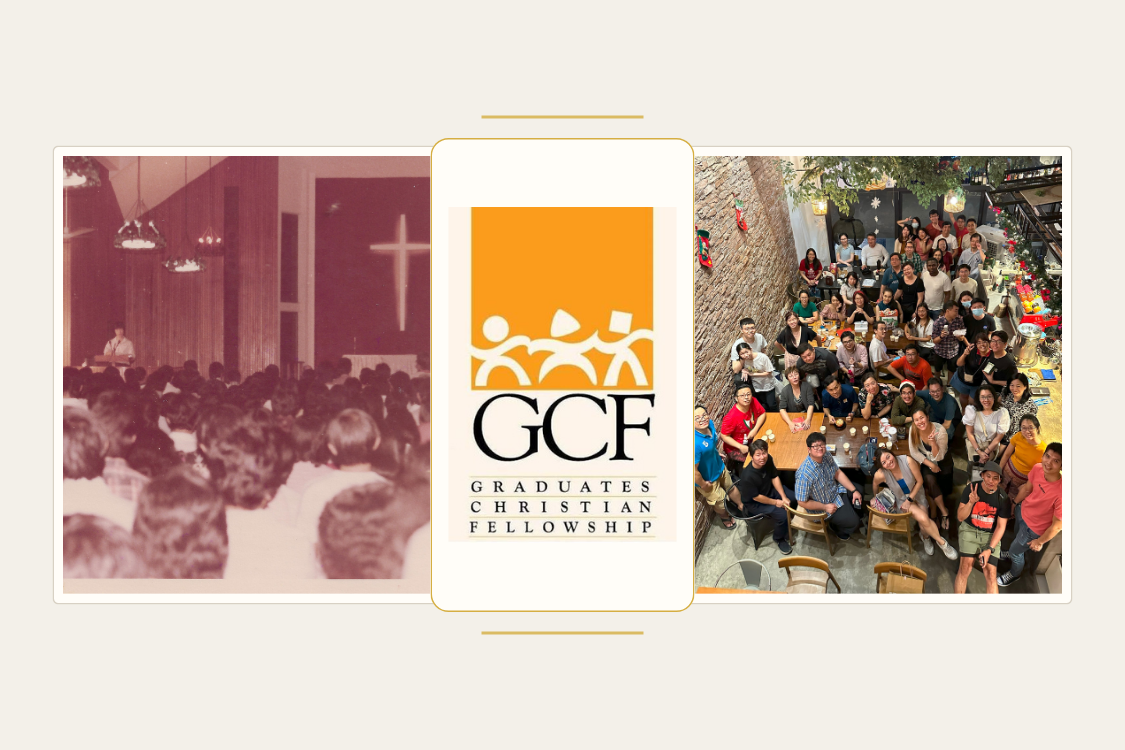
Two Saturdays ago, on the 15th of August I attended the 56th Thanksgiving Dinner of the Graduates Christian Fellowship (GCF), Malaysia. I had been on staff with them in the mid-’90s. For some reason, I had not attended a similar event all these years. I was invited for this one and I was glad to go. It had a full-circle feel about it.
GCF was the part of the Fellowship of Evangelical Students (FES) ministry that focused on discipling college and university graduates, while the FES ministry focused on undergraduates. My joining the staff of GCF came at a tumultuous time for me and for the organisation. I had been serving as a pastor before then, but very difficult personal circumstances meant that I did not have the energy to lead a church. However, I believed I had the energy to play a more focused role, as executive secretary of GCF.
It was also a tumultuous time for GCF. She had always struggled to raise support and manpower. And with the coming of Kairos, a Christian think-tank ministry headed by an outstanding local scholar, people were beginning to question if there was a need for GCF at all. Should we humbly accept the fact that our days were over and “close shop”? It was also a time when many churches were beginning to have their own student and young adult ministries. Was GCF still needed?
I thought that if GCF was primarily functioning as a thought leader then maybe others can also do this and do it better. FES ministries tend to focus on teaching. If that was the main thing we did, it was right to question if there was a need for GCF. If GCF were to continue there had to be a relook at the mission of the organisation. Together with the leaders, we settled on three key defining components of a mission going forward.
Who
We were not seeking to minister to everyone. Our target group was the Christian graduate and we wanted to pay special attention to those who were transiting from tertiary education to working life. We believed that this was particularly important because a fresh grad who made that transition well would be on a good trajectory for the rest of his life. In those days, there were not that many universities and colleges and so this was still an important demographic of Christians who deserved proper formation for their post-campus life.
What
What did we try to convey to these fresh graduates? Because there were not that many who managed to get a tertiary education in those days, there was always the danger of elitism and a sense of entitlement and privilege defining the mindset of graduates. The question we had to continually pose to them was: Is tertiary education a passport to privilege or is it preparation for service? We wanted to challenge graduates, especially fresh graduates, to be servant leaders in church and society. Even then we were challenging any sacred-secular divide and wanted the GCF constituency to understand the spiritual significance of serving the Lord in all spheres of life, including the marketplace, where most graduates were most of the time.
How
The question then was “how”? How do we equip graduates to be servant leaders in church and society? Traditionally, FES-related groups were strong on delivering content through teaching, publishing, Bible studies, and conferences. This was very important at a time when graduates were trying to figure out what it meant to follow Christ in different contexts. I felt that instruction was not enough. People were transformed relationally. FES did have fellowship groups but I thought we needed a more intentional, relational, mentoring programme. I asked the Lord to lead me to some young graduates and invited them to a small-group mentoring experience. I called this a Head Start group, aimed at giving fresh graduates a head start in following Christ in the working world. I was delighted that that worked well. Two from the group, Alvin Ung and James Daniel, brought this practice to a national level and eventually this led to the iBridge ministry, helping tertiary students bridge the gap between student life and working life.
Of course GCF did much more than iBridge, but looking back from 30 years on I am glad that we didn’t shut down GCF. My personal circumstances resulted in my eventually leaving my role in GCF. The leaders were very kind and supported me as best they could. But I felt I didn’t want to negatively affect the work and I moved on.
Looking back has evoked mixed feelings. There was a reminder of sad times. Yet, meeting many old friends and seeing how GCF has thrived through the years also gave me much joy.
