
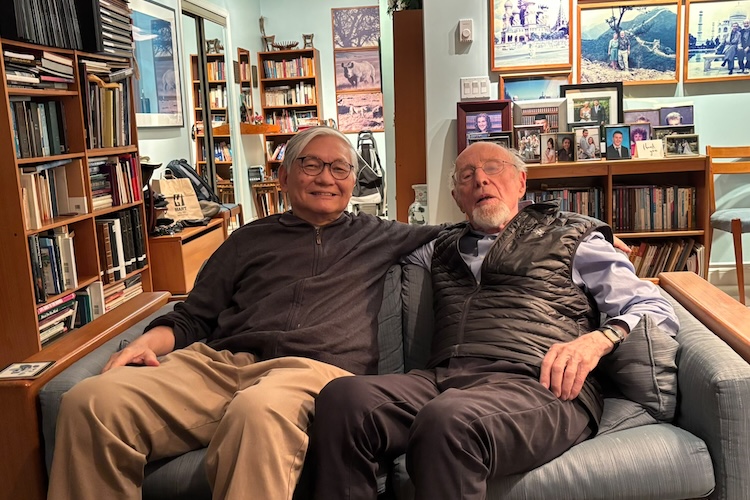
I am happy to report that Paul Stevens is alive and preaching. He is 89 but still doing his stuff. Had to put this out first because usually when I write about my Regent Profs, they have graduated to heaven. Bernice and I had a joyful reunion with him. I think we may not have met him for over a decade. He invited us to his place for dinner and insisted on doing all the cooking. Gail, his wife, and also our very dear friend, had passed away in 2021. Friends told us that he was doing well and he is. He has a number of health challenges, and he only has one working eye. There are some things that come with age for all of us, but his passion, his mind, are still top notch, and we had scintillating conversations.
I had wanted to tell him that his impact meant that the Graduates Christian Fellowship of Malaysia took a decidedly marketplace direction after a seminar we had with him and after he had made several teaching visits to Malaysia and Singapore. Influenced by his teaching, the Malaysian GCF adopted this mission: Equipping Servant Leaders for the Marketplace. He had made a major impact on a national movement. This is but one example of how he has impacted the church worldwide, in helping the church see that all of God’s people are called to do God’s work, and His work is not merely restricted to church-related vocations.
Here are two excerpts from a recent article he wrote that captures some of his deepest convictions:
It started with an absolute commitment to the whole people of God, the so-called laity, being called, equipped and commissioned by the Lord himself to the work of ministry in all of life—home, church, workplace and neighbourhood. I wanted to develop a down-to-earth spirituality of everyday life.
I do not believe there is a laity in Christ. We are all ordained through our baptism, as early Baptists practised by the laying on of hands for commissioning as the person emerged from their watery grave to serve Christ full time. The church has no laypeople in the usual sense of that term (unprofessional, second class) but it is full of clergy in the true meaning of that word (commissioned, blessed and honoured). This becomes especially clear when you consult the original Greek. Laikos, the word for “layperson” is never used in the New Testament to describe a Christian. And the word for “clergy” kleros is never used exclusively to describe church leaders.
These are convictions I have also held to, even before I came to Regent, probably influenced by the writings by Stevens, Ward Gasque, and Robert Banks.
In Exodus, Moses had hoped for the day when all would be prophets (Numbers 11:21–30). And Pentecost (Acts 2:1–41) was a super game changer. In the Old Testament, the Spirit came on special people for special callings, e.g., kings and prophets. Now the Spirit was poured out on all. All of God’s people were now “special” and anointed for ministry. We are indeed a nation of priests (1 Peter 2:9 cf. Exodus 19:6).
The continued division of God’s people into clergy and laity, a distinction that I, and others like Paul Stevens, don’t hold to, is unhealthy for the church. First, it puts impossible expectations on pastors. Every day we hear of pastors leaving the pastorate, or those who soldier on but struggle with serious emotional problems. I know some of these pastors. I was one of them for a time. While each church and each pastor may have their unique struggles, we may need to also ask if the pastorate as we have it today is really what the Lord had in mind.
If we have discouraged pastors, we also have disappointed laity who see their clergy not functioning to the level they think their clergy should. Many of the laity see themselves as primarily recipients of ministry, not givers of ministry. Even if they are involved in lay ministry, they don’t see their ministry as having the same spiritual importance as the work of their pastors.
Just imagine a scenario where there are no clergy and laity, just the people of God, all anointed by the Spirit and therefore all having the spiritual equipment, and all having the responsibility to serve. No wonder the early church turned the world upside down.
This does not mean that all Christians have the same roles. As 1 Corinthians 12 and Romans 12 teach us, the members of the church, like the different parts of the body, have different functions. Some among us will be called to serve as leaders and teachers, but this describes their function and not their status.
Nowadays we hear a lot about the marketplace ministry movement. It wants the church to see that ministry is not just restricted to Sundays and the church, and therefore not just to the clergy. Most followers of Christ serve in the world, not in the church, and most do their work Mondays to Fridays in non-church related jobs. This movement wants to challenge the laity to understand their daily work as also God’s work and the marketplace as a context for bringing Kingdom values into their “secular” work. They want Christians to see the marketplace as an important place for evangelism and discipleship.
I think this movement has brought a very important corrective to the ministry of the church. However, note that this movement talks about place (marketplace) and activity (work). It perhaps assumes but does not explicitly mention the identity of the Christian. So several people have noted that though the marketplace ministry movement is now recognised and pursued, there is little talk today of the laity movement. The recovery of the proper understanding of the laity and its implications is far more wide-ranging and significant than just the recovery of a broader understanding of the meaning of our work.
I asked Paul if he was disappointed that a cause he had given himself to for most of his adult life seemed to be in decline. He said he was, though he has seen signs of life in various churches around the world. I am here in Regent on sabbatical seeking the Lord for guidance as to what I should focus on in my ministry going forward. I think I have received part of the answer.