
“But we don’t get to determine how God will speak. Instead, we are invited to engage in the active spiritual practice of paying attention, of taking notice of what God has to say in God’s way.” [1]
For the longest time, all that I had heard or read about Iona had led me to one conclusion—I had to set foot on this special island in the Inner Hebrides. The opportunity finally arrived when our dear friend and spiritual director, Stanley Tay, decided to lead a group of us on a pilgrimage to this “cradle of Christianity” off the west coast of Scotland.
Apart from the opportunity to reconnect with many of our friends at a deeper level during this journey, the unique quality of Iona as a “thin place” [2] drew each of us deeper into God. Even the journey there was somehow inspirational too. While I was eagerly anticipating all that I would find on Iona, it was in the getting there that God dropped a spiritual gem.
As you may have read in Soo Inn’s piece on Iona two weeks ago, there were many parts to our journey. One of these was a one-and-a-half-hour bus ride from Craignure to Fionnphort on the Isle of Mull to catch the ferry to Bailé Mor on Iona. Nothing too unusual there, you are thinking, yes? Well, this huge bus that could carry all 18 of us (and many others as well), had to make the whole journey on a single-lane road! It also had to navigate the crossing of two small, single-lane bridges! We held our communal breaths each time the driver had to approach a bridge. It was like trying to fit a jigsaw-puzzle piece in a rather awkward position. We needn’t have worried, though. We made it across with nary a scratch on the bus!
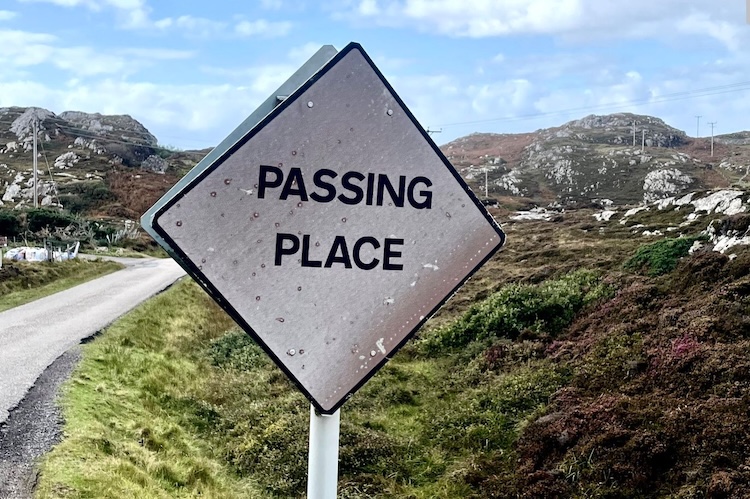
What caught my attention as we journeyed along past swathes of fir trees on the mountain sides were the signs that would whizz by ever so often: “Passing Place”, they read. These indicated the presence of a layby at the roadside that literally allowed vehicles coming from opposite directions to pass by each other. Often, the driver that spotted the oncoming vehicle first would pull into the layby so that said vehicle would be able to proceed smoothly on its journey. Invariably, this favour would be returned many times more down the line (lane). Such civility among drivers! No one cussed nor swore for having been made to wait. Says I who comes from a country where drivers are often far less patient and readily voice their displeasure with a raised hand or a loud honk.
I subsequently learned that there are rules governing the passing places:
- If the passing place is on your LEFT: Pull into it and allow the oncoming vehicle to proceed.
- If the passing place is on your RIGHT: Stop opposite it so the oncoming driver can pull into the passing place on their left.
- Reversing: If you are nose-to-nose with another vehicle between passing places, the driver who is closest to a passing place should reverse. Always ensure you can reverse your vehicle before driving these roads.
- Yielding to others: Use passing places to allow traffic behind you to overtake.
- Never park: Passing places are strictly for traffic manoeuvres; never park in them.
The very scenic route across Mull took us past mountains, lochs (lakes of varying sizes), rams and ewes with their spring lambs, fuzzy-faced Hairy Coos (Highland Cows whose appearance alone already gave us so much joy), and the occasional homestead. As I travelled past more Passing Places, it got me to thinking about instances of figurative “Passing Places” in the Bible.
Rahab’s home became just such a place for the two spies sent by Joshua to check out Jericho (Joshua 2). The upshot of her generous care of the men was her (and her family’s) escape from the horrific destruction of Jericho.
A generation later, Rahab’s son, Boaz, became another passing place—he was the kinsman redeemer of Ruth the Moabite widow. The fruit really didn’t fall far from the tree for Rahab and Boaz. Three generations later, David was born. When he needed to escape the wrath of King Saul, he sought refuge in a physical passing place, in the cave of Adullam. The Bible is replete with examples of passing places, whether human or structural. And I’m reminded of the verse in Philippians 2 which exhorts us to,
“Do nothing from selfish ambition or conceit, but in humility count others more significant than yourselves. Let each of you look not only to his own interests, but also to the interests of others. Have this mind among yourselves, which is yours in Christ Jesus …” (vv 3–5)
It is only when we can set aside our own interests and think of the other that we’ll begin to take notice of opportunities to be passing places. As we move on from the Old Testament to the New, we encounter even more examples, climaxing, of course, with the ultimate Passing Place—Jesus Christ, who died that we might live.
Would you consider looking to the interests of others and not only to your own? You just might discover that you, too, can be (have been) a passing place?
_________
[1] Tracy Balzer, A Journey of Sea and Stone: How Holy Places Guide and Renew Us, (Minneapolis: Broadleaf Books), 7.
[2] Ibid., 18.